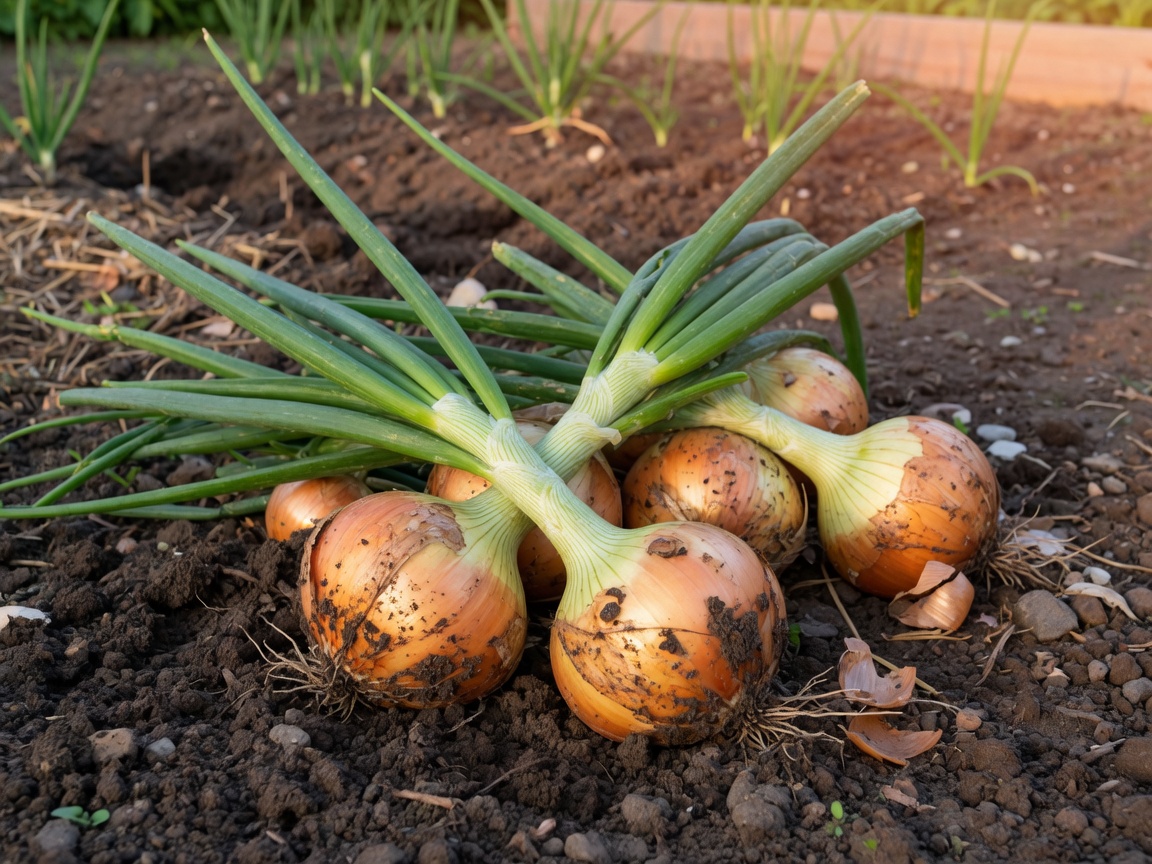
Onions
Allium cepa — day-length divas with underground agendas
- SunFull sun, all of it.
- WaterEven moisture ~1"/week; ease off at cure.
- SoilLoose, fertile, well-drained; pH ~6.0–7.0.
- TypeLong-day varieties for Kennewick latitude.
- PlantSets/plants early spring (Mar–early Apr).
Sunlight
Onions need full sun. Bulbing is tied to day length and plant size when the critical day length hits. Weak, shaded plants enter the bulbing window undersized and stay undersized. There is no late-season magic spell.
- Open bed, no tree canopy, no “it gets sun after 2 p.m.” delusion if that’s only 3 hours total.
- Keep weeds down—onions do not compete well. Weeds will humble your rows while you’re not looking.
Soil
Roots are relatively shallow and picky about structure. Rocks, clods, and crusty clay grow weird, split, or undersized bulbs.
- pH: target 6.0–7.0. Highly alkaline Basin soils can still produce if fertility and organic matter are managed—test if growth is chronically poor.
- Texture: loose sandy loam amended with compost is ideal. Heavy clay needs organic matter and raised beds.
- Fertility: onions are nitrogen users early (for leaf canopy) then need balanced conditions as bulbs swell.
- Avoid: fresh manure right before planting (soft growth, weed seeds, odor, regret).
Watering schedule
Steady moisture grows steady bulbs. Drought early = small plants = small bulbs. Flooding constantly = rot risk and shallow lazy roots.
Guidelines
- Establishment: keep soil evenly moist so sets/plants root in. Don’t let the top few inches go to dust for weeks.
- Active leaf growth (spring–early summer): about 1 inch of water per week equivalent; more on pure sand and windy weeks.
- Bulbing: maintain even moisture. Inconsistent water can contribute to splits and doubles when combined with other stresses.
- Tops falling over / maturity: reduce watering. You’re finishing bulbs for cure/storage, not launching a late vegetative festival.
- After harvest: cure in a dry, airy place—not a damp plastic bag in the garage swamp corner.
Kennewick practicality
- Drip irrigation along rows is excellent—targets roots, limits weed water between rows.
- Mulch lightly to hold moisture, but don’t bury necks in wet muck.
- Spring can be cool; don’t drown cold soil. Summer will demand more consistency as heat arrives.
Fertilizer
Think in two acts: grow leaves first, then finish bulbs. Leaf canopy size roughly predicts bulb size. Tiny tops do not become softball onions through hope.
- Pre-plant: compost + fertilizer with available nitrogen in poor soils.
- Side-dress #1: about 3–4 weeks after planting if growth is slow/pale.
- Side-dress #2: mid-growth while leaves are still expanding.
- Ease off heavy nitrogen as bulbs size up and maturity nears—late N can delay finishing and hurt storage quality.
- Water after fertilizing. Always. Dry fertilizer + dry roots = burn, and then you’ll blame “bad sets.”
Day length: the part everyone skips
- Long-day onions: best default for northern areas including Kennewick. They start bulbing when days get long in early summer.
- Intermediate-day: some gardeners succeed; read variety notes.
- Short-day: generally wrong tool here for big storage bulbs.
- Sets vs plants vs seed: sets are easy; plants (transplants) often make nicer bulbs; seed is cheapest and slowest (start indoors winter).
Planting & spacing
- When: as soon as soil is workable in spring—often March to early April in the Basin.
- Spacing: 3–4 inches for medium bulbs; 4–6 inches for larger. Rows 12–18 inches.
- Depth: sets pointy-end up, barely covered; transplants at similar depth to how they grew, roots spread, not wadded.
- Weed control: onions lose to weeds. Mulch, cultivate shallowly, hand-pull. Neglect is a yield reduction strategy.
Harvest & curing (or enjoy rot later)
- When ~half to most tops fall over naturally, bulbs are finishing.
- Lift gently; don’t leave mature bulbs through weeks of irrigation like you’re trying to rehydrate a mummy.
- Cure in a warm, dry, shaded, airy place until necks are dry and skins rustle (often 1–3 weeks).
- Store cool, dry, ventilated. Soft, thick-necked bulbs don’t store—eat those first.
- Green onions can be harvested anytime you need them and emotional support alliums.
Problems
- Small bulbs: wrong day-length type, late planting, shade, weeds, low N early, drought.
- Bolting: temperature swings / large sets sometimes; harvest and use.
- Rot in storage: incomplete cure, wet necks, bruised bulbs, humid storage. Fix process, not just “next year’s luck.”
- Thrips: silvery leaf scarring under hot dry conditions—common enough; healthy plants often still yield; heavy pressure may need management.